Oh, the misery of decision-making when hunger strikes! Picture this: you’re staring at a menu with more options than you can count, stomach rumbling like a thunderstorm, and you’re expected to pick just one dish. Sounds familiar?
Feel overwhelmed by multiple choices could be a sign of decision fatigue. Our brains have a breaking point, a limit to how many decisions they can handle before they start feeling fried. As our cognitive abilities get worn out by having to make dozens conscious and unconscious decisions every day, decision-making skills go downhill.

And it’s not just about what’s on the plate; the desire to make eco-conscious choices adds a whole new layer of complexity. Sustainable fashion, ethical eats – the options are endless, and the info overload can leave you feeling like a deer in headlights. From checking if it’s nutritious enough to pondering over the carbon footprint of that Mexican avocado, the questions keep piling up.
Is it vegan? In season? Local or just off a jet around the globe? And let’s not forget the production conditions – is it fair labor or a shady operation hiding on faraway soil?
Packaging becomes the next battleground – plastic-covered or wrapped in unnecessary waste? Is it nutritious, organic, or secretly laced with pesticides plotting a slow takeover of your health in the next five decades?
Amidst all this decision chaos, one question stands out – is it something you actually want to eat? Because, let’s be honest, after all these considerations, it better be worth every bite!
Hold on tight because today’s blog post won’t hand you all the answers; it might just stir up more questions (sozzzzz).

Meaty Environmental Impact
When it comes to the environmental impact of our food, most of it comes from land use and the farming process, making up more than 80% of the footprint for many foods. Transport, on the other hand, plays a smaller role, contributing to less than 10% of emissions for most food items and even less for the big greenhouse gas emitters. In beef from beef herds, transport only makes up 0.5% of the total footprint. And it’s not just about transport – everything that happens after the food leaves the farm, like processing, transport, retail, and packaging, also contributes only a small part to the emissions.
For instance, producing a kg of beef emits 60 kilograms of CO2-equivalents, while peas emit just 1 kilogram per kg. Land use change and farm-stage processes contribute over 80% of the footprint for most foods, with transport accounting for less than 10%.
Deciphering Locality and Transport Logistics
Defining ‘local’ raises questions about proximity and borders. Is it about the distance from the supplier to the consumer, or does it involve country borders? For now, let’s go with the former and set a limit of 500 km. This means a product from the Netherlands is considered local not just within the Dutch tulips market but also in parts of several other European countries.
The impact of transport is minimal for many products, except for highly perishable items often transported by air. Although air freight emits significantly more CO2eq than sea transport, it represents only a small fraction of food miles. Avocados and almonds are examples of foods commonly assumed to be air-freighted but are predominantly transported by boat (but the beloved avo toast and almond milk cappu are problematic for other reasons – more on that below).

Food Miles, Production Methods, and Emissions
What about similar products coming from different regions? Storing British apples in cold storage for 10 months results in double the emissions compared to transporting South American apples by sea to the UK. The scale and mode of transportation are crucial factors: if you drive more than 10 km to buy 1 kg of fresh produce, it generates more GHG emissions than air-freighting an equivalent amount from Kenya. Additionally, maritime transport is shown to produce 25 to 250 times fewer emissions than trucks, while air freight emits five times more on average than road transport.
Ok, but what about shorter distances? Take Swedish tomatoes versus Spanish tomatoes, for example. Research suggests it is more environmentally friendly, in terms of greenhouse gases, for Sweden to opt for Spanish tomatoes. Why? Because the Spanish ones are grown in open fields, while the local ones rely on greenhouses heated with fossil fuels. Plus, different farming methods involve varying inputs like pesticides and fertilisers.
The Thirsty Tale of Avocados
Avocado farming isn’t just about nice dips and toast toppers – it’s an incredibly water-intensive process. In places like Petorca, Chile, a major supplier of avocados to the UK, it takes a whopping 320 litres of water to grow a single avocado, compared to the average of 70 litres. To put it in perspective, that’s about four times the water needed to produce almonds for almond milk.
But avo production isn’t just thirsty; it’s also linked to deforestation, particularly in Mexico, the global avocado powerhouse. As avocado plantations expand — global cropland devoted to this one fruit went up from 188,000 hectares in 1980 to 807,000 hectares in 2020 — forests are cleared at an alarming rate, contributing to climate change, habitat loss, increased carbon emissions, and soil erosion.
Plant-Based Milk: A Greener Sip
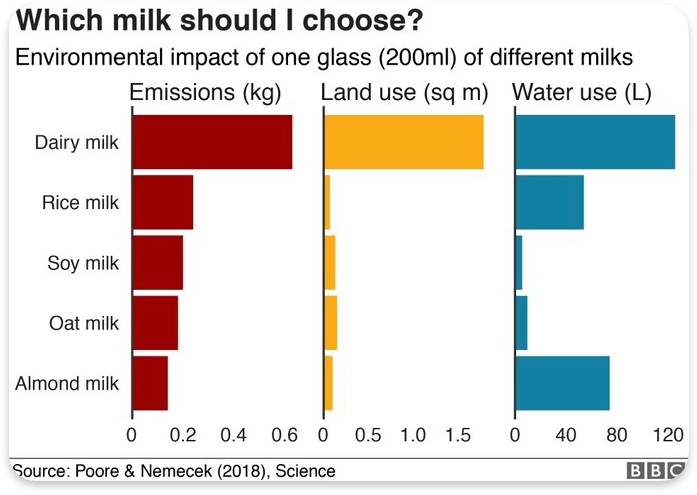
First off, any plant-based milk, whatever it is made of, has a significantly lighter impact on greenhouse gas emissions, water, and land use compared to dairy. Multiple studies, including systematic reviews, unanimously support this notion. For example, the global warming potential of cow’s milk ranges from 1.14 to 2.50 kilograms of carbon dioxide equivalent per liter, depending on the region, while plant-based milks average at just 0.42 for almond and coconut milk and 0.75 for soy milk.
Dairy, in general, demands nine times more land than plant-based alternatives. Every liter of cow’s milk requires 8.9 square meters per year, whereas oat, soy, almond, and rice milk use significantly less land. Water usage tells a similar story, with dairy needing 628 liters for every liter produced, compared to 371 for almond, 270 for rice, 48 for oat, and 28 for soy milk.
Breaking it down:
- Almond Milk:
- Pros: Almond trees absorb carbon and produce useful woody biomass.
- Cons: High water use in water-scarce areas, concerns about bee mortality due to pesticides in intensive almond production.
- Coconut Milk:
- Pros: Generally good environmental performance; coconut trees use small amounts of water and absorb carbon dioxide.
- Cons: Grown only in tropical areas, leading to potential wildlife habitat destruction with increasing demand.
- Hazelnut Milk:
- Pros: Environmentally friendly due to wind-based cross-pollination; lower water usage in regions around the Black Sea, Southern Europe, and North America.
- Cons: Potentially expensive and not widely available.
- Soy Milk:
- Pros: Versatile plant with good environmental performance in terms of water, global warming potential, and land use.
- Cons: Associated with clearing native vegetation for soybean growth; potential decrease in demand needed to witness changes.
- Hemp Milk:
- Pros: Deep roots improve soil structure, reduce need for herbicides and pesticides; less water usage compared to almond and dairy.
- Cons: Produced in low quantities despite being environmentally beneficial.
- Rice Milk:
- Pros: Widely available and inexpensive.
- Cons: Large water footprint; higher greenhouse gas emissions due to methane-producing bacteria in rice paddies; potential arsenic concerns; fertilizers used may pollute waterways.
- Oat Milk:
- Pros: Increasingly popular with overall environmental benefits, easy to make at home.
- Cons: Often grown in large-scale monoculture, depleting soil fertility and limiting biodiversity; use of glyphosate-based pesticides tarnishes its environmental credentials.
Navigating Green Decision Fatigue
To lighten your carbon footprint, steer clear of air-freighted foods, especially the quick-to-spoil ones like asparagus, green beans, and berries. If there is a label, check it for the product’s origin.
Yet, rather than getting bogged down by the “eat local” dilemma, there’s a more impactful route to reducing your carbon footprint. Shifting away from meat and dairy can be a game-changer. Diversifying your choices and taking a closer look at factors like packaging can further slash your overall environmental footprint. The takeaway is clear: embrace plant-based options for a greener culinary adventure.
***
The challenges I tackled today were five-minute shower, no single-use plastic, compost (autopilot mode on), vegan food, learning new things about sustainability and taking my email inbox from 700 unread messages to zero.
Hitting the delete button on your emails isn’t just a digital clean-up—it’s an eco-friendly move. Each email you send or store has a carbon footprint, contributing to the environmental impact of our digital age. In fact, an average year of emailing emits around 136 kilograms of CO2e, which is roughly equivalent to driving 200 miles in a gas-powered car. Even when emails are tucked away in storage, they continue to demand energy.
On the flip side, I made a mindful choice to skip volunteering today, prioritising self-care. As my mom notes, a messy room mirrors a messy mind – the older I get the better I understand her. Spending hours cleaning up my flat became a form of self-care, creating physical and mental space. A call with my parents afterwards added an extra layer of joy to the day. Attempting to drop off my brimming 9L compost bin at the designated point was a fail —the compost site was closed, so I will need to go back another day.
To sum up, this is today’s progress:
| SUCCESS | FAIL |
|---|---|
| Compost (coffee) | Volunteering |
| Learn new sustainability info | Compost disposal (biiiiig lol) |
| Vegan food | Unplug devices that are not in use |
| Five-minute shower | |
| Digital clean-up | |
| No single-use plastic waste |

 Fair February
Leave a reply to Cycling Through Change – Fair February Cancel reply